By: Skeeter Hrisca
Student ID: (31206123)

Introduction
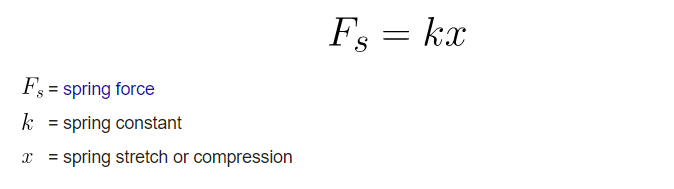
This blog will be exploring Hooke’s Law by conducting an experiment on elastic materials. The aim of the experiment is to determine the relationship between the force applied and the deformation of the elastic material.
What is Hooke’s Law
Experiment
AIM:
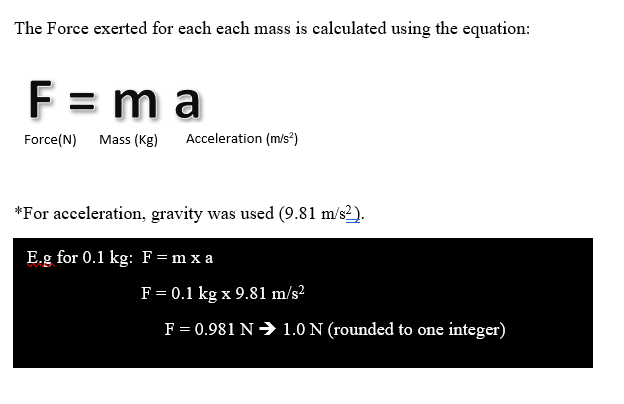
Experimenting Hooke’s Law by observing the relationship between force applied and stretch of a material. In addition to this, monitoring the change in behaviour when an item has gone beyond its elastic limit*. The experiment will use mass to stretch the elastic. The force used can then applied by using the formula: F (force)= m (mass) x a (acceleration).
*Elastic limit: the maximum length to which a material can be stretched while being able to return to its original shape
EQUIPMENT:
- Three springs (y1, y2 and z)
- Ring stand
- Clamp
- Ruler
- Known mass
METHODOLOGY:
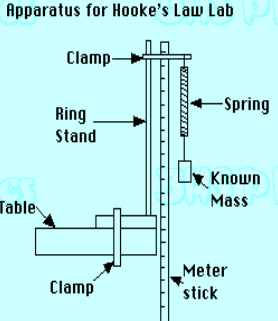
First, the ring-stand was set up with the clamp connected. Then one spring (y1) was attached to the end of the clamp. A mass was hooked on to the spring and the extension (in millimetres) was measured using a ruler. A different mass was attached each time and the extension was measured (this was repeated 10 times for the same spring). Then the experiment was repeated with the other two springs (y2) and (z). For the spring (z), its behaviour was being measured while past its elastic region: inelastic region. This meant that the deformation it undertook was no longer reversible.
RESULTS:
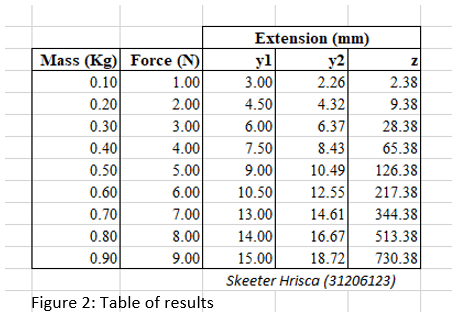
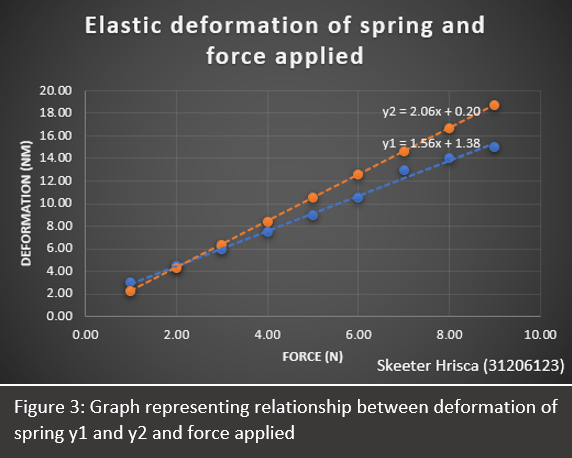
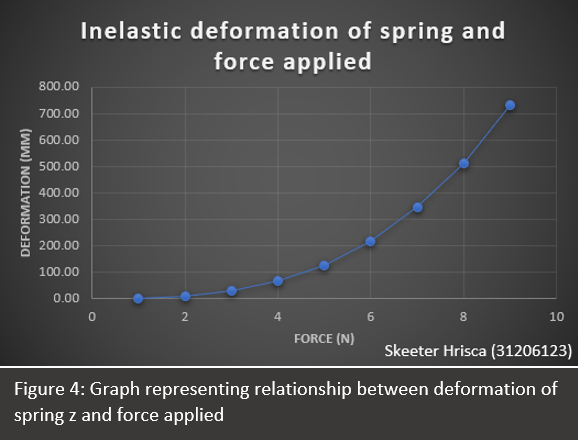
Two graphs were plotted, one with the spring results of (y1) and (y2). The other graph had the inelastic deformation of spring (z).
DISCUSSION:
In the first graph (Figure 3), showing the elastic deformation of the two springs, there is a linear progression. It is evident that there is a positive correlation between the force applied and the deformation of the spring. However, for line (y1), it is not a perfect linear correlation since one of the results (y1 = 13.00 mm) resonates outside the expected value for a perfect linear line. This slight error could have been caused by a random error; for instance there could have been a misreading when observing the length extended.
The second graph (Figure 4) displays the inelastic deformation of a spring that has gone beyond its elastic limit. There is a positive relationship between the force applied and the deformation of the spring. However, unlike spring (y1) and (y2), the progression is exponential rather than linear. This is the expected result because the deformation being measured is inelastic. Since the material will not return to its original form, it can be stretched as far as possible with the necessary force.
CONCLUSION:
In conclusion, Hooke’s Law was confirmed through the experimental data obtained. The data for spring (y1) and (y2) clearly shows a positive correlation, proving that as the elastic deformation of the spring is directly proportional to the force used to extend (F α E). On the other hand, for the last spring (z), Hooke’s Law can no longer be applied because it has reached the limit of proportionality*; hence why the graph displayed is no longer linear.
*Limit of proportionality: the point of an elastic material to which Hooke’s Law can no longer be applied.
References
- Image 1- Available at: https://www.environmentalscience.org/physics Accessed on: 06/11/2019
- Figure 1- Available at: http://www.batesville.k12.in.us/Physics/PhyNet/Mechanics/Newton3/Labs/SpringScale.html Accessed on: 06/11/2019
- Experiment- Available at: http://www.batesville.k12.in.us/Physics/PhyNet/Mechanics/Newton3/Labs/SpringScale.html Accessed on: 06/11/2019
- Hooke’s Law- Hooke’s Law – density, elastic limit Available at: http://physicsnet.co.uk/a-level-physics-as-a2/materials/hookes-law/ Accessed on: 06/11/2019
- Elastic limit and limit of proportionality- Forces and elasticity – AQA – Revision 2 – GCSE Combined Science – BBC Bitesize Available at: https://www.bbc.co.uk/bitesize/guides/z9hk3k7/revision/2 Accessed on: 10/11/2019

